English
Views: 0 Author: Site Editor Publish Time: 2026-09-03 Origin: Site


Choosing the wrong material causes rapid equipment degradation, poor surface finishes, and wasted capital. Buyers often face a tough dilemma at the decision stage. You need the right combination to succeed. We must view material options across two critical categories. First, you have the consumable abrasive media pumped through the system. Second, you must evaluate the physical materials of the cabinet hardware. This includes the main body construction and the viewing window. If these elements clash, performance plummets. A robust abrasive shreds weak hardware. Conversely, poor media struggles inside a heavy-duty setup. This article introduces a practical framework. We will help you match abrasive media and cabinet build materials directly to your specific operational goals. You will learn how to align these choices with strict compliance requirements. By the end, you will confidently select materials optimizing your entire blasting process.
Media Dictates ROI: Aluminum oxide offers aggressive cutting and high recyclability, while glass beads are superior for non-destructive surface peening.
Hardware Must Match the Abrasive: Aggressive materials require heavier-gauge steel cabinets and specialized nozzles (e.g., boron carbide) to prevent internal wear.
Window Clarity is a Safety Metric: Tempered glass with tear-off protectors outlasts acrylic, reducing downtime and operator error.
Supplier Support Matters: Evaluating a sandblast cabinet supplier involves checking the availability of wear parts, warranty terms, and media compatibility guarantees.
There is no universal material for every project. Your selection depends entirely on the base substrate type. You must consider the specific anchor pattern required. Production volume also plays a massive role here. Soft aluminum requires a completely different approach than hardened steel. We categorize these operational tasks into two distinct areas. You either perform aggressive surface preparation or delicate peening.
Surface preparation involves aggressive material removal. You use this process to strip heavy rust. It easily removes mill scale and thick old coatings. The primary goal is exposing bare metal quickly. This creates a rough, textured surface profile. We measure this anchor profile in mils. A deeper profile provides better adhesion for heavy industrial coatings. You must use angular media to achieve this physical bite.
Peening is a completely non-destructive finishing process. Operators use it for visual polishing and mechanical stress relief. You do not remove any base material during peening. The media simply dimples the surface upon impact. This action compresses the outer metal layer. It prevents micro-cracks from forming under stress. You must use spherical media to achieve proper peening. Angular media will destroy the peening effect instantly.
Recyclability heavily influences your overall operational efficiency. We must evaluate the abrasive breakdown rate carefully. Cheaper abrasives fracture very quickly upon initial impact. Coal slag provides a common example of this problem. It shatters into microscopic dust almost immediately. This fine dust easily overwhelms standard filtration systems. Your dust collector fills up rapidly. This causes severe visibility drops inside the workspace.
Harder media requires a larger initial upfront investment. Aluminum oxide serves as the perfect example here. However, it survives multiple blast cycles easily. It performs exceptionally well in a sealed closed-loop system. You extract the shattered particles automatically. The intact media returns to the blasting nozzle. You replace the abrasive media much less frequently. This continuous loop maximizes your daily production uptime.
Choosing the right abrasive transforms your workflow inside any sandblast cabinet. Each media type offers distinct advantages for specific substrates. They also carry unique operational risks you must manage.
Aluminum Oxide: This is best for fast cutting and heavy rust removal. It etches hard metals effectively before powder coating. It boasts a very high Mohs hardness rating. However, it causes high wear on standard ceramic nozzles. It also degrades unprotected cabinet walls over time.
Glass Beads: We recommend this for delicate cleaning and surface peening. You achieve a smooth, satin finish easily. It cleans surfaces without altering critical dimensional tolerances. The main risk involves media fracturing. Glass breaks easily under high impact. You must carefully keep air pressure below 80 PSI.
Silicon Carbide: This tackles the hardest substrates available today. You use it primarily for glass etching or stone carving. It introduces severe operational risks internally. It causes extreme equipment wear almost immediately. You must install specialized high-durability plumbing to survive it.
Plastic Media & Walnut Shells: These excel in automotive restoration and aerospace maintenance. They strip paint gently without damaging soft substrates. You can safely clean aluminum and fiberglass. They operate at much slower cutting speeds. They also create potential organic dust hazards requiring specialized filtration.
Media Material | Particle Shape | Ideal Application | Hardware Wear Level |
|---|---|---|---|
Aluminum Oxide | Angular | Rust removal, heavy etching | High |
Glass Beads | Spherical | Polishing, non-destructive peening | Moderate |
Silicon Carbide | Sharp/Angular | Stone carving, glass frosting | Extreme |
Plastic / Organics | Irregular | Gentle paint stripping | Low |
You must match your abrasive media to your hardware capabilities. The specific density of the chosen material matters greatly. It must align closely with the air compressor’s CFM output. Heavy media requires massive air volume to move efficiently. Lightweight media flows well under lower air volumes. You also need to consider the core blast system type. Siphon systems handle different media than direct pressure systems.
Siphon systems use simple suction to draw media upwards. They work perfectly for lighter abrasives like glass beads. Direct pressure systems use a pressurized containment vessel. They push media at much higher velocities. Direct pressure handles heavy steel grit effortlessly. It strips heavy rust significantly faster. You must evaluate your production speed requirements carefully.
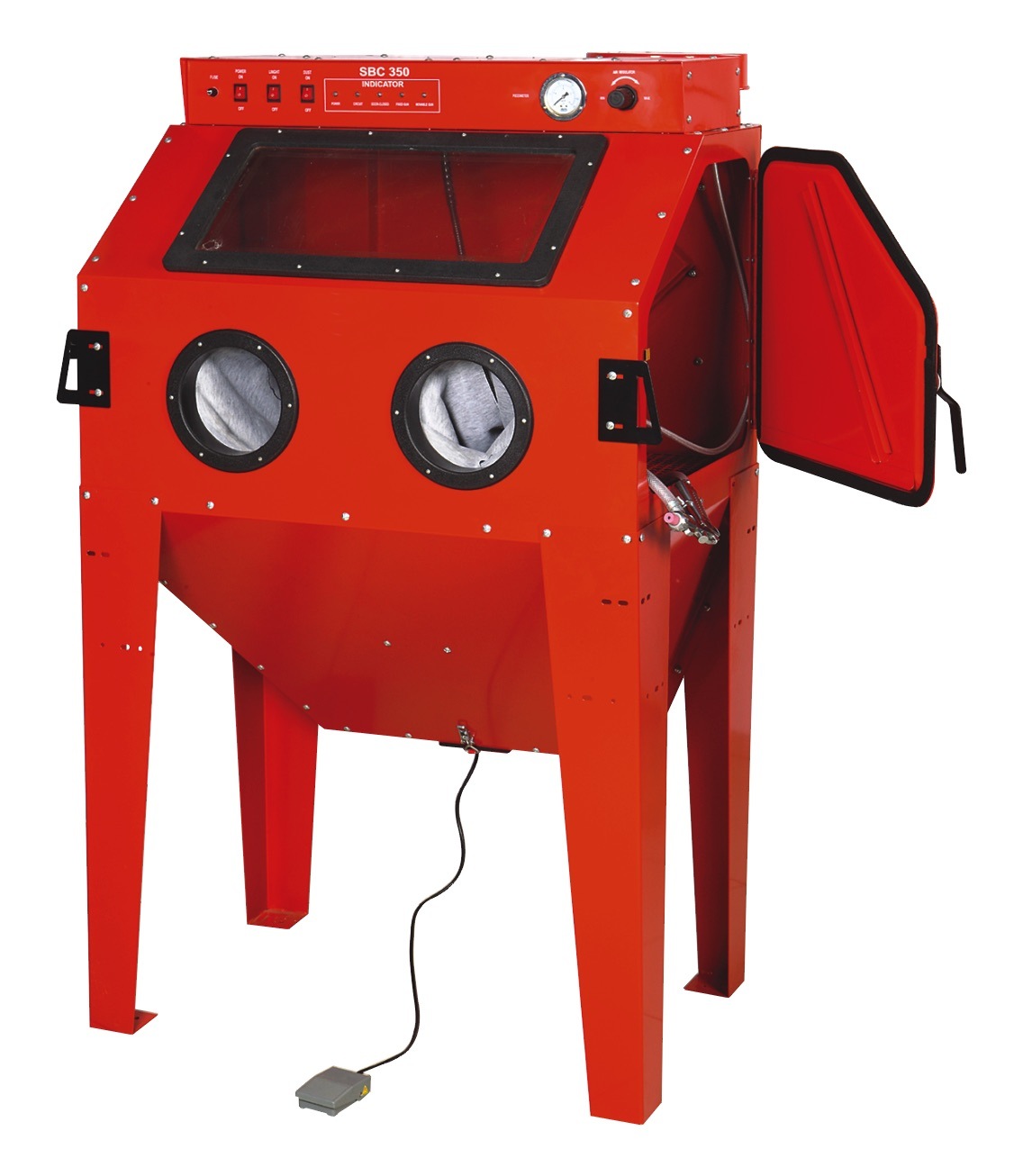
Let us examine hardware compatibility using a benchmark model. The sandblast cabinet dj sbc350e illustrates mid-range industrial capabilities perfectly. These technical details directly dictate your media limitations. For instance, the hopper angle must suit the media weight. Steep angles prevent heavy abrasives from bridging inside the funnel. Shallower angles work fine for lighter plastic media.
Dust collection requirements also dictate material choices strongly. Friable materials break into microscopic particles upon impact. Crushed glass and coal slag fall into this category. They demand higher-capacity dust extractors immediately. Strong extraction maintains clear visibility inside the enclosure. It also ensures OSHA compliance regarding airborne particulates. Proper filtration keeps operators safe and highly productive.
Hardware longevity depends heavily on physical construction materials. You must evaluate the main body construction carefully before purchasing. Manufacturers typically use steel or specialized plastics. Welded steel remains ideal for heavy daily industrial use. We recommend 14-gauge or 16-gauge steel for harsh abrasives. Thicker steel resists warping and internal erosion. Welded seams prevent hazardous dust from leaking outwards.
High-density polyethylene offers a completely different advantage. It is entirely rust-proof and very lightweight. Manufacturers rotationally mold this material to eliminate weak seams. This makes it suitable for lighter hobbyist use. It also performs exceptionally well in damp garage environments.
Viewing window selection is equally critical for operator safety. You have two primary options on the market:
Acrylic or Plexiglass: These windows are much cheaper to replace initially. However, static electricity causes dust to cling to them. They pit and fog almost immediately under abrasive spray. You will lose critical visibility very quickly.
Tempered Glass: This requires a slightly higher initial cost. It resists static buildup much better than plastics. It also resists microscopic pitting for a longer period. Tempered glass shatters safely if an accidental impact occurs.
You must follow a strict operational implementation rule. Always mandate a cabinet design accepting replaceable Mylar tear-off shields. You need this regardless of the base window material chosen. These thin protectors take the abrasive damage instead of the glass. You simply peel off the damaged shield mid-shift. This restores perfect visibility in seconds without tools.
Finding the right vendor ensures long-term operational success. We recommend specific shortlisting logic to evaluate vendors properly. Avoid suppliers making unrealistic claims about total media versatility. No single machine handles every abrasive flawlessly without modifications. A good vendor explains how aggressive media affects internal hardware. They guide you toward appropriate protective upgrades.
Parts availability is another critical vetting factor. Ensure your chosen vendor stocks essential consumables locally. They must tailor these replacement parts to your chosen media. For example, silicon carbide requires specialized boron carbide nozzles. Standard ceramic nozzles will fail in a few hours. You will also need replacement window shields and heavy-duty gloves constantly. A reliable vendor ships these items quickly to minimize downtime.
Compliance and safety should finalize your purchasing decision. Check if the vendor provides proper environmental performance guarantees. Ensure their sandblast cabinet specifications meet local occupational safety standards. This includes strict regulations for mitigating airborne silica and particulates. Reliable vendors provide documentation proving their extraction systems perform safely. They incorporate safety door interlocks to protect operators. They also offer foot pedal controls to reduce hand fatigue.
Selecting the ideal material requires a carefully calculated equation. You must balance the abrasive media needed for the job with robust cabinet hardware. Both elements must work together seamlessly to prevent breakdowns. To ensure long-term operational success, follow these final action steps:
Prioritize hardware specifications matching your most aggressive abrasive requirement.
Design your system around your highest-volume production tasks to future-proof the investment.
Install Mylar tear-off window shields immediately to preserve visibility and operator safety.
Consult an engineering team to verify compressor CFM compatibility before finalizing a purchase.
Request a media sample test from your shortlisted vendor to confirm surface finish results.
A: No. It contains free silica, posing severe health risks including silicosis. It also contains heavy moisture and organic impurities. These contaminants will clog your cabinet plumbing rapidly and ruin the entire extraction system.
A: It depends completely on the media hardness and blasting pressure. Harder media like aluminum oxide recycles multiple times efficiently. Glass beads break down much faster. Replace the media when cutting speed drops noticeably. You should also replace it if dust levels suddenly spike inside the enclosure.
A: You are likely using aggressive media without a protective tear-off shield installed. Alternatively, the high-pressure blast stream is ricocheting directly off the workpiece onto the window. Use Mylar protectors to mitigate this issue instantly and adjust your blasting angle.