English
Views: 0 Author: Site Editor Publish Time: 2026-10-16 Origin: Site


Evaluating workshop equipment often brings a classic buyer dilemma. You must assess if 12 tons of force will cover your planned projects or if a larger model is strictly necessary. Choosing incorrectly means risking a stalled project or serious frame damage. The ideal user for a 12-ton unit includes DIY auto mechanics, small-scale fabricators, and hobbyist gunsmiths. However, rated tonnage rarely equals functional output. Frame deflection and bottle jack quality significantly impact real-world performance. In this guide, we explore exactly what these machines can handle. You will uncover their true limitations, hardware variations, and critical safety protocols. We also share practical insights for maximizing your shop efficiency and ensuring every press operation goes smoothly.
A standard 12 ton shop press is highly versatile for daily garage work. Mechanics rely on it for numerous drivetrain and suspension tasks. Fabricators utilize the consistent pressure for shaping metal components. Understanding optimal use cases prevents equipment abuse and ensures project success.
Removing and installing interference-fit components requires steady, even pressure. Standard wheel bearings on passenger cars seat tightly inside steering knuckles. A 12-ton hydraulic unit breaks this friction bond easily. You position the knuckle on support plates, align your pressing adapters, and apply downward force. The bearing typically yields with a loud snap before sliding out smoothly.
Pressing out stubborn control arm bushings presents a similar challenge. Rubber bushings fuse to steel sleeves over years of road use. Hammering them out damages the control arm. A hydraulic press pushes the steel sleeve directly. U-joints on passenger cars and light SUVs also succumb quickly to this pressure. You press one side of the yoke to eject the opposite bearing cap, making U-joint replacement a five-minute task.
Fabricators frequently transform these machines into compact press brakes. Bending brackets and thin-gauge steel becomes highly repeatable. A well-built unit bends mild steel up to 1/4-inch thick. However, the maximum bending width depends entirely on your die setup and the material's yield strength. Narrower pieces require less tonnage to fold.
Beyond bending, you can use the hydraulic ram for specialized detailing. Setting heavy solid rivets takes seconds under hydraulic pressure. Knife makers and leatherworkers stamp logos using custom steel dies. Machinists frequently mount broaches to cut small keyways into pulleys and gears. The slow, controlled ram speed prevents tool chatter and ensures a clean cut.
Straightening bent shafts or motorcycle forks is a delicate operation. You cannot simply smash the metal back into shape. This task requires careful setup and measurement.
General shop maintenance also benefits from a dedicated press. Compressing heavy coil springs requires caution but is highly effective. Some users even build custom containment enclosures to crush old oil filters. This drains residual oil and reduces shop waste volume significantly.
Knowing your equipment's breaking point is critical for shop safety. Pushing a machine beyond its design limits invites structural failure. Users must recognize when a project requires heavy-duty industrial equipment instead.
Standard passenger car components rarely require maximum force. However, 3/4-ton or 1-ton truck wheel bearings present a different reality. These massive bearings endure extreme loads and frequently rust solid inside their housings. Road salt and heat cycles fuse the metals together. Breaking this rust bond often requires 20 or more tons of breakaway force. Applying merely 12 tons to a seized F-250 bearing will stall the ram. The jack will bypass fluid internally before the bearing ever moves.
Metal forming demands exponentially more energy as surface area increases. Attempting to coin or forge solid cold-rolled steel will quickly identify failure points. 12 tons provides immense pressure across a one-inch punch. Spread that same force across a six-inch die, and the pressure per square inch drops dramatically. Deep drawing thick sheet metal or flattening heavy steel plates exceeds the structural limits of this equipment.
Structural realities dictate actual pressing power. When you push a budget unit to its maximum rating, the frame absorbs much of the energy. H-frame uprights begin twisting outward. The upper crossbeam bows upward under the strain. This phenomenon is called frame deflection. Frame deflection bleeds off applied force before the workpiece actually yields. You may pump the jack to 12 tons, but the workpiece only experiences a fraction of that energy. The rest is trapped as dangerous stored energy within the bending steel.
Shop Press Task and Capacity Thresholds
| Task Description | Material / Vehicle Type | Expected Force Needed | 12-Ton Press Capability |
|---|---|---|---|
| Wheel Bearing Removal | Honda Civic / Toyota Camry | 3 to 6 Tons | Excellent |
| U-Joint Replacement | Jeep Wrangler / Ford Ranger | 4 to 8 Tons | Very Good |
| Sheet Metal Bending | 1/8" Mild Steel (Narrow) | 5 to 10 Tons | Good |
| Seized Hub Removal | Ford F-350 / Ram 2500 | 18 to 30+ Tons | Will Fail |
| Cold Forging | Solid Bar Stock | 40+ Tons | Will Fail |
Not all machines are built equally. Visual similarities often hide inferior metallurgy and weak hydraulics. Evaluating the underlying hardware ensures you purchase a tool capable of safe, repeatable work.
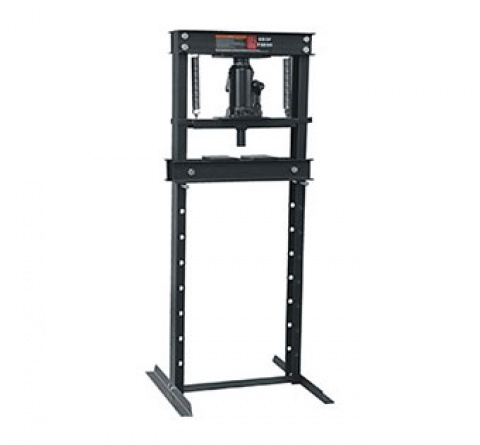
Frame design dictates overall stability. H-frames dominate the market for good reason. They utilize vertical steel channels bolted or welded to heavy crossbeams. This creates superior lateral stability. A-frame designs are lighter and less rigid. They often flex dramatically under uneven loads. When evaluating an H-frame, inspect the steel thickness. Heavy-gauge C-channel steel is essential for preventing catastrophic failure under load. Thin, folded sheet metal uprights will buckle if you press an off-center workpiece.
The heart of any press is its hydraulic cylinder. Stock bottle jacks vary wildly in quality. Cheap jacks suffer from short stroke lengths and poor internal seals. A short stroke means you must constantly pause your work, lower the bed, and add spacer blocks. Seal quality dictates how long the jack holds pressure without bleeding down.
Certain standard configurations, such as the 12t shop press 0901B, showcase practical engineering. They utilize universally sized bottle jacks. This ensures excellent parts availability. If the hydraulic seals eventually fail, maintenance is straightforward. You can easily unbolt the carriage and swap out the hydraulic unit for a fresh one. Many users eventually upgrade their manual jacks to air-over-hydraulic units. This allows for push-button operation using a shop compressor.
Arbor plates support your workpiece. Budget machines frequently ship with cheap cast-iron plates. Cast iron is exceptionally brittle. It does not bend under extreme stress; it shatters. Shattered plates launch heavy metal fragments across the garage. We highly recommend discarding cast-iron plates immediately. Replace them with machined mild steel or AR400 armor plate. Minimum thicknesses for replacement steel plates should be at least one inch for safety.
Bed adjustability impacts your daily workflow efficiency. Assess the bed adjustment mechanism carefully. Thick support pins endure immense shear forces. Ensure the pins fit snugly into the upright holes. Large gaps allow the bed to tilt during pressing. Closer hole spacing allows for finer height adjustments, reducing your reliance on dangerous spacer stacks.
Even the highest-quality frame poses severe risks if used improperly. Proper installation and strict safety protocols are non-negotiable. Hydraulic force commands deep respect in any environment.
Garages rarely have spare floor space. Here, the 12-ton footprint offers a massive advantage. These units tuck easily into tight corners. They require significantly less overhead clearance than 20-ton or 30-ton commercial presses.
However, this compact footprint introduces a tipping hazard. These machines have a high center of gravity. The heavy crossbeam and jack sit far above the base legs. You must mandate floor bolting for your installation. Use heavy concrete anchors to secure the feet. Off-center pressing tasks generate lateral forces. Floor bolting prevents the entire machine from tipping forward onto the operator.
Bearing failure is violent. When a seized bearing finally shatters under pressure, it releases enormous stored energy. The danger of projectile shrapnel is very real. Basic safety glasses offer insufficient protection against flying steel chunks.
A: Yes, for most standard passenger cars and light trucks. The force generated easily overcomes the friction of standard interference fits. However, severely rusted bearings on larger heavy-duty vehicles may exceed its capacity. If the ram stalls, do not force it.
A: H-frames offer higher tonnage capabilities and enclosed stability for automotive work. The dual uprights prevent twisting. C-frames provide open, three-sided access for awkward workpieces. However, C-frames are typically limited to lower tonnages and smaller overall footprints due to their open design.
A: Yes, replacing the stock jack with an air-over-hydraulic jack is a common and popular upgrade. This modification speeds up workflow. Ensure the replacement matches the original dimensions and never exceeds the frame's specific 12-ton structural rating to avoid catastrophic frame failure.
A: Stock cast plates on budget models are notorious for failing under max load. Cast iron is brittle and shatters violently without warning. Upgrading to heavy-duty, machined steel plates or AR400 plate is highly recommended for your personal safety in the shop.