English
Views: 0 Author: Site Editor Publish Time: 2026-09-06 Origin: Site


Mismatching equipment carries high operational risks. Undersized units compromise safety and often lead to catastrophic mechanical failures. Conversely, oversized frames waste valuable budget and block essential floor space. Facility managers, mechanics, and procurement teams need an objective evaluation tool. Moving from initial research to a final purchase requires clear, uncompromising parameters. We designed this guide to provide a realistic, engineering-based framework. You will learn to properly evaluate capacity, footprint, and reliability. This ensures you secure the exact lifting tool for your unique workshop demands.
Capacity is dynamic: A shop crane’s maximum rated capacity decreases as the boom extends; buying based purely on static weight risks failure.
The 2-ton baseline: A shop crane 2t model provides the most versatile load-to-footprint ratio for standard automotive and light industrial applications.
Footprint matters: Folded dimensions and caster quality dictate real-world usability in confined shop environments.
Supplier vetting prevents downtime: Sourcing from a verified shop crane supplier ensures access to replacement hydraulics and structural warranty support.
Most buyers misunderstand how rated lifting limits actually work. A crane does not lift its maximum load at every setting. Understanding this basic engineering principle keeps your team safe.
Lifting equipment relies heavily on the physics of leverage. An extended boom acts as a longer lever arm against the main hydraulic cylinder. As you pull the boom outward to reach further into an engine bay, the structural capacity drops significantly. A 2-ton shop crane only lifts a full 4,000 pounds when set to its shortest boom position. Pushing the boom out to its maximum reach often reduces the lifting limit to just 1,000 pounds. You must plan your lifts around the extended capacity, not the static maximum.
You need to calculate the absolute heaviest item your facility will lift. Do not estimate this number. Use a systematic approach to determine your Maximum Realistic Load (MRL):
Identify the heaviest object: Choose your largest typical load. For example, a fully dressed diesel engine weighs significantly more than a bare cast-iron block.
Add the accessories: Include the weight of the load leveler, chains, slings, and any attached transmission bell housings.
Apply a safety factor: Multiply your total calculated weight by 1.25 or 1.30. Adding a 20 to 30 percent safety margin protects the equipment from sudden dynamic shocks during lifting.
Match to extended capacity: Compare this final number against the crane's capacity at your required boom extension distance.
Weight represents only half of the lifting equation. You must also evaluate vertical lift height. Mechanics often struggle when they clear the engine mounts but cannot lift the block high enough to clear the vehicle's front grille. Measure the required vertical lift height in your facility. Consider the height of lifted truck beds, machine tool enclosures, or high-clearance 4x4 vehicles. Your chosen equipment must provide enough ram stroke to safely extract and transport these loads without snagging.
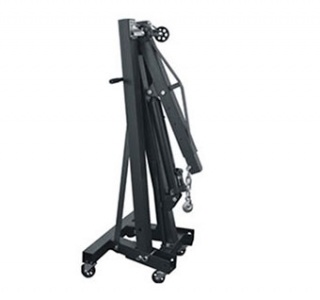
When you browse industrial catalogs, you will notice a specific capacity class dominates the market. Understanding why professionals favor this size helps you make a smarter purchasing decision.
The shop crane 2t provides an unparalleled cost-to-capability ratio. One-ton variants often struggle with modern, fully dressed V8 engines or heavy industrial lathe chucks. Three-ton variants provide massive power, but their sprawling bases consume too much floor space. The 2-ton model hits the perfect sweet spot. It offers enough structural rigidity for heavy diesel blocks while remaining nimble enough for general shop maneuvering.
Shop Crane Capacity Comparison Chart
Capacity Class | Primary Application | Footprint Size | Maneuverability |
|---|---|---|---|
1-Ton | Motorcycles, small ATVs, lawn equipment | Small | High |
2-Ton | Automotive, light industrial, diesel blocks | Medium | Excellent |
3-Ton | Heavy fleet trucks, large machinery | Large | Low |
The hydraulic ram acts as the heart of your lifting equipment. You must scrutinize these components carefully when reviewing shop crane specifications. Look specifically for dual-pump pistons. A dual-pump design moves the boom upward twice as fast when unloaded, saving your technicians significant time. Furthermore, demand bypass valves. An automatic bypass valve prevents operators from over-extending the hydraulic ram. This internal safety mechanism stops the jack from failing under extreme pressure.
Never ignore the raw materials. Manufacturers build high-quality lifting equipment using heavy-gauge tubular steel. Thin-walled steel flexes under load, creating a dangerous pendulum effect. Inspect the stress points around the mast base and boom pivot. Professional units feature reinforced gussets at these critical junctions. High-grade hardware also matters. Ensure the manufacturer uses Grade 8 structural bolts rather than cheap, unmarked hardware.
Even the strongest lifting equipment becomes a burden if it blocks your daily workflow. Workshop real estate costs money. You must account for storage and mobility before you process a purchase order.
Storage pain points frustrate mechanics constantly. If you purchase a folding frame model, you must measure your facility first. Do not just look at the deployed operating dimensions.
Measure the exact square footage of your dedicated storage corner.
Check the vertical clearance where you plan to store it. Folded masts sit quite high.
Verify the folding mechanism uses captive pins so your team does not lose critical hardware.
Calculate the aisle width to ensure you can roll the folded unit through your shop doors.
Many buyers ignore the wheels. This mistake destroys shop floors. Cheap plastic casters often drag under heavy loads rather than rolling smoothly. When plastic wheels flat-spot, they gouge expensive epoxy floor coatings. They also get stuck in expansion joints. You want heavy-duty steel casters or high-capacity polyurethane swivel casters. Polyurethane offers excellent floor protection while bearing immense weight. Ensure the design includes multi-directional swivel casters at the rear for tight steering.
Mechanics frequently overlook equipment leg clearance. The crane legs must roll completely under the vehicle or machine tool to position the hook directly over the load center. If your equipment legs measure eight inches tall, they will never slide under a low-profile sports car or a standard forklift. Measure the ground clearance of the equipment you service. Compare those measurements against the height of the crane's base legs. Buying a low-profile base option often solves this common frustration.
Workplace accidents destroy businesses. You cannot compromise on structural safety when suspending thousands of pounds in the air.
Professional facilities require tested equipment. Always look for established manufacturing and safety standards. CE certification demonstrates compliance with European safety, health, and environmental protection requirements. In the United States, look for ASME PASE (Portable Automotive Service Equipment) compliance. These certifications separate rugged, professional-grade equipment from unreliable hobbyist tools. They prove the manufacturer passed rigorous independent load testing.
You must approach every new equipment evaluation through a skeptical lens. Look for immediate warning signs. Porous, inconsistent welds indicate sloppy manufacturing and weak structural joints. Thin-walled square tubing feels unusually light and twists during operation. Another massive red flag involves the hydraulic cylinder. If the manufacturer does not offer replacement seal kits or rebuild instructions, they treat the hydraulic ram as a disposable item. You want equipment built for a decade of service, not a single season.
Build Quality Evaluation Matrix
Component | Professional Quality Indicators | Warning Signs to Avoid |
|---|---|---|
Steel Frame | Thick gauge tubing, reinforced gussets | Thin metal, noticeable flex when pushed |
Welds | Smooth, continuous, consistent beads | Porous gaps, excessive spatter, uneven lines |
Hydraulics | Dual pump, bypass valve, rebuild kits available | Single pump, sealed/non-serviceable unit |
Hardware | Grade 8 steel bolts, captive locking pins | Unmarked bolts, loose cotter pins |
Some fabricators attempt to build custom lifting equipment to save money. This path carries severe liability risks. Fabricating your own lifting equipment exposes your facility to massive insurance liabilities if a weld fails. Commercial manufacturers spend thousands of hours testing metal fatigue and hydraulic stress. Buying a tested, commercially rated unit costs far less than a workplace injury settlement. Leave the engineering to dedicated factories.
Your relationship with the manufacturer begins after the purchase. Choosing the right vendor ensures your equipment operates reliably for years.
Hydraulic seals eventually wear out. Caster bearings degrade over time. You must frame your vendor choice around post-purchase support. If a cylinder blows a seal, you need immediate access to replacement parts. A reliable shop crane supplier maintains a deep inventory of replacement jacks, seals, and structural pins. Do not buy from importers who treat the equipment as disposable and fail to stock spare parts.
Review the warranty fine print before issuing a purchase order. Establish baseline expectations. Professional suppliers typically offer a one-year warranty on hydraulic components and a lifetime warranty on the structural steel frame. Additionally, ask about shipping timelines. Transparent suppliers provide accurate lead times and realistic freight quotes. Unreliable vendors hide behind vague shipping dates and obscure delivery fees.
You might encounter assembly issues or need specific load data. Emphasize the importance of technical support during your shortlisting phase. The best suppliers gladly provide complete technical drawings, detailed load charts, and clear assembly documentation before you ever spend a dime. If a sales team cannot answer basic engineering questions about their own products, cross them off your list.
Securing the right lifting equipment fundamentally improves your facility's safety and efficiency. The optimal choice balances your maximum extended-boom capacity needs against your realistic storage footprint constraints. Remember to factor in dynamic loads, carefully measure your leg clearances, and insist on heavy-duty casters.
Your next steps require precise measurements. Finalize your maximum load calculations using the 1.25 safety factor. Measure your aisle widths and dedicated storage spaces. Do not guess these dimensions.
Once you gather your internal data, move forward confidently. View detailed product specification sheets, download a comprehensive sizing guide, or contact a technical sales team. Securing application-specific advice today prevents expensive equipment mismatches tomorrow.
A: No. Capacity drops incrementally as you extend the boom due to leverage physics. A standard unit might lift 2 tons at its shortest position, but drop to 1.5t, 1t, and 0.5t as you pull the boom outward. Always check the load chart for extended capacities.
A: Most 2-ton folding models require a modest footprint. They typically range from 30x40 inches to 36x48 inches of floor space when fully collapsed. Always measure your exact vertical clearance, as folded masts can stand quite tall.
A: We strongly advise against this. Retrofitting a higher-capacity ram onto a lower-capacity steel frame creates extreme danger. The original steel frame is only engineered to support the original ram's maximum limit. Overpowering the frame causes catastrophic metal buckling.
A: You should request independent load-testing certificates before issuing a purchase order. Furthermore, ask the vendor for detailed engineering spec sheets. Reliable suppliers transparently share CE or ASME PASE compliance documents alongside complete structural dimension charts.