English
Views: 0 Author: Site Editor Publish Time: 2026-09-14 Origin: Site


Purchasing industrial equipment at scale amplifies both operational potential and financial risk. A single defective unit causes minor inconvenience for a maintenance crew. However, a systemic flaw across a bulk order results in widespread downtime. It also creates severe safety liabilities and compromises your entire return on investment. A successful bulk procurement requires moving beyond standard marketing brochures. You must implement a rigorous, evidence-based inspection framework.
This guide provides a systematic evaluation protocol for quality assurance teams. Procurement managers can use it to vet technical capabilities thoroughly. We will explore how to verify manufacturing consistency and mitigate risks before you finalize a bulk purchase. You will learn to identify red flags in structural integrity. We will also cover how to audit hydraulic performance and validate critical safety compliance. By applying these strict standards, you protect your workforce and streamline your facility's daily operations.
A high-quality shop press relies entirely on its foundational structure. The frame must absorb and distribute immense pressure without warping. Evaluating this structure is the most critical step in bulk procurement.
Inspect the thickness of the steel used in the H-frame. Thinner gauge steel compromises rigidity and safety under maximum tonnage. High-capacity presses demand heavy-duty, low-carbon steel like A36 or higher yield grades. You should measure the flange and web thickness of the vertical uprights. Measure the horizontal crossbeams as well. Undersized channel iron will eventually yield under continuous cyclic loading. This causes permanent deformation.
Look for continuous, deep-penetration welds rather than intermittent tack welds. Stress fractures in bulk orders often originate from poor factory welding. Inspect the joints connecting the uprights to the base and the upper crossbeam. Superior manufacturing utilizes robotic MIG welding for consistent bead profiles. Hand-welded units may exhibit porosity, undercut, or incomplete fusion. These defects act as stress concentrators. They will crack during heavy pressing operations.
Evaluate the adjustment mechanism of the press bed. Carriage pins must fit tightly without excessive play. Loose pins create an uneven pressing surface. This unevenness causes off-center loading, which damages the hydraulic ram. Winch mechanisms for heavier beds should operate smoothly without binding. Inspect the cable thickness and the routing pulleys. A binding winch creates severe pinch hazards for operators.
Establish an acceptable tolerance for frame bowing under load. Excessive deflection indicates substandard material strength. During your initial sample inspection, apply the maximum rated load. Place a dial indicator on the upper crossbeam. Measure the vertical displacement. A rigid frame should exhibit minimal deflection and return exactly to zero once you release the pressure. Permanent set indicates the frame has exceeded its elastic limit.
The hydraulic system acts as the heart of the machine. Even a massive steel frame is useless if the hydraulics fail. Bulk orders magnify the impact of cheap seals and inefficient pumps.
Hydraulic leaks are the primary failure point. Identify the manufacturer of the internal seals. Polyurethane seals offer superior abrasion resistance compared to basic nitrile rubber. They boast a much higher rated lifecycle. Ask the manufacturer about their seal sourcing. Off-brand seals degrade quickly under high pressure. This degradation leads to fluid bypass, ram drift, and messy shop floors.
Evaluate the actuation method against your facility's operational tempo. You can choose manual, pneumatic, or electro-hydraulic pumps. For bulk deployments, pneumatic or electric pumps reduce operator fatigue significantly. Manual pumps work well for infrequent use. However, high-volume production requires automated fluid delivery. This automation ensures consistent cycle times.
| Pump Type | Best Use Case | Operator Fatigue | Cycle Speed |
|---|---|---|---|
| Manual Hand Pump | Low volume, precision work | High | Slow |
| Pneumatic (Air/Hydraulic) | Medium volume, maintenance bays | Low | Moderate |
| Electro-Hydraulic | High volume, continuous production | Very Low | Fast |
Ensure hydraulic gauges are liquid-filled. The liquid dampens vibration and protects the delicate internal mechanism. Gauges must be calibrated accurately to reflect true force. They should not just measure internal fluid pressure. A dry gauge will vibrate violently during a heavy press stroke. This makes accurate reading impossible and destroys the gauge over time.
Verify the presence and factory calibration of pressure relief valves. These valves prevent operators from exceeding the maximum rated capacity. If an operator tries to press a component requiring 40 tons on a 30-ton machine, the relief valve must open. It safely bypasses the fluid back to the reservoir. You must test this bypass function during your sample inspection.
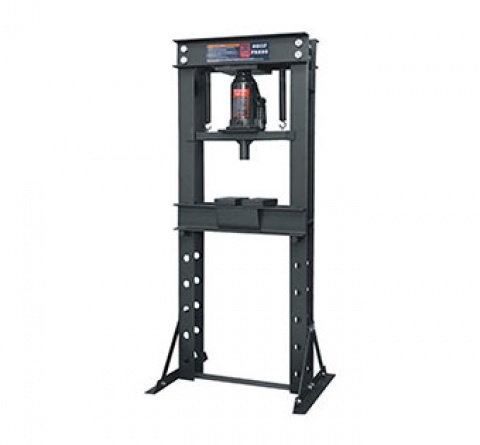
Marketing brochures often exaggerate performance metrics. You must validate the engineering data through physical testing before authorizing a bulk purchase.
A common industry discrepancy is labeling peak capacity as continuous working capacity. If procuring a 30t shop press, demand testing documentation. This documentation must show the unit safely holds 30 tons without pressure drop over a set duration. It must also resist structural warping. Budget manufacturers often use pump pressure ratings rather than actual ram force. You should mandate physical load cell testing to confirm true force delivery.
Verify the ram travel distance. We call this the stroke. You also need to verify the maximum working distance, known as the daylight. You must cross-reference shop press specifications against your specific tooling requirements. If your facility processes tall components, inadequate daylight makes the machine useless. Similarly, a short stroke requires operators to constantly adjust the heavy bed. This wastes valuable production time.
In a bulk order, dimensional consistency between units is critical. Standardized workflow setups rely on identical machines. Inspect a sample batch for uniform manufacturing tolerances. If bed widths or ram diameters vary wildly from unit to unit, you will face severe tooling issues. Your custom jigs and pressing fixtures must fit perfectly into every single machine you receive.
Industrial presses generate immense destructive force. A minor component failure under high pressure creates lethal shrapnel. Bulk procurement protocols must prioritize operator safety and regulatory compliance.
Evaluate the availability and quality of shatter-resistant safety shields. Pressing operations often involve brittle materials. Bearings or cast iron parts can shatter violently. Machines should feature polycarbonate shields or heavy wire mesh. These guards protect operators against component fragmentation. Ensure the guards adjust easily so operators actually use them.
Request documentation proving alignment with regional occupational safety standards. Look for OSHA, CE, or ANSI certifications. Specifically, refer to standards like ANSI B11.2 for hydraulic presses. Legitimate manufacturers provide compliance certificates readily. Do not accept self-certified documents without third-party laboratory verification. Regulatory non-compliance opens your business to massive legal liability.
Assess the footprint and pre-drilled mounting holes. Equipment must secure firmly to the floor. Heavy offset pressing creates tipping moments. If an operator presses a stubborn bearing off-center, a narrow machine can topple over. Verify the base plates are sufficiently wide. Check the steel thickness at the mounting points to prevent bolt pull-through.
Procuring a fleet of machines means you are entering a long-term relationship with the manufacturer. You must evaluate the business entity just as rigorously as the steel they weld.
A credible shop press supplier will allow comprehensive sample testing. They should provide video evidence of sample testing from your specific production run before shipping. FAT protocols verify the machinery meets all agreed-upon specifications while still at the factory. You can mandate specific workpieces for these tests. If a supplier refuses FAT requests, walk away immediately.
Scrutinize the warranty terms specifically tailored for bulk purchases. Ensure guaranteed lead times for replacement wear parts. You will eventually need seals, return springs, and pressure gauges. A machine waiting weeks for a proprietary seal creates unacceptable downtime. Your supplier must maintain a robust domestic parts inventory. They should offer guaranteed overnight shipping for critical components.
Request material test reports (MTRs) for the steel. Ask for certifications for the hydraulic components. This rules out the use of counterfeit or rejected raw materials. Shady factories sometimes substitute high-grade steel with cheap, recycled scrap to increase margins on bulk orders. MTRs provide a documented paper trail tracing the steel back to the original foundry.
Eliminate suppliers who refuse to provide component-level sourcing data. Walk away if they balk at requests for pre-shipment inspection protocols. A transparent supplier welcomes rigorous quality audits. They view your inspection criteria as validation of their own manufacturing excellence. Prioritize partners who offer dedicated engineering support and rapid technical troubleshooting.
Inspecting a bulk shop press order requires a zero-trust approach to technical specs and supplier promises. You must focus your attention heavily on frame rigidity and verifiable safety mechanisms. Hydraulic reliability ultimately dictates the working lifespan of the equipment. Treat every specification as a claim requiring physical proof. By systematically auditing materials, welds, and hydraulic configurations, you protect your capital investment.
Before issuing a purchase order, request an evaluation unit. If that is impossible, mandate a comprehensive Factory Acceptance Test utilizing your specific workpieces. Do not rely entirely on the manufacturer's generic test blocks. Draft a customized Service Level Agreement with your supplier regarding defect rates and replacement logistics. This proactive approach guarantees your new fleet of equipment performs safely and efficiently from day one.
A: A healthy hydraulic system should hold its maximum rated load for at least 10–15 minutes with zero visible pressure drop on the gauge. If the needle falls steadily, the cylinder seals are bypassing fluid or the pump check valve is leaking. Reject units that cannot maintain static pressure.
A: It depends on the manufacturer. Quality presses deliver their rated tonnage directly at the ram. Budget models often rate the pump's theoretical maximum output. This force is lost through cylinder friction and system inefficiency. Always require physical load cell testing to prove true force delivery.
A: Implement a randomized sampling protocol upon arrival. We recommend inspecting 10 to 20 percent of the total shipment. Check for transit damage and hydraulic fluid leaks. Perform a dry run of the ram travel. Verify the bed winch operates smoothly and all carriage pins align perfectly.